Administrative
Career
The official record establishes the fact of service in the Indian Administrative Service and the cadre in which it was served. It does not publish a list of postings, districts, designations or dates. This section therefore sets out what is established, explains what the service itself involves, and leaves the unestablished blank rather than filling it.
The service, verbatim
“Served as IAS officer in the various capacities in Rajasthan Cadre”
“Shri Meghwal is a retired IAS Officer from Rajasthan”
What is established, and what is not
A ledger kept honestly must record its own gaps. Rows marked not published are not omissions of research; they are the state of the official record.
| Period | Position | Institution | Responsibility | Source |
|---|---|---|---|---|
| Pre-2009 | Officer, Indian Administrative ServiceDescribed in the parliamentary record as service “in the various capacities” | Government of Rajasthan — Rajasthan cadre | Not published in the official profile | Digital Sansad |
| Individual postings | Not publishedNo designation, district or department is listed in the official record | — | — | — |
| Year of entry / retirement | Not publishedThe official profile records that he is a retired IAS officer; it does not give dates | — | — | — |
| 2011–2014 | Co-ChairmanCommittee on the Reservation in Judiciary | National Commission for Scheduled Castes | Institutional committee work on reservation in the judiciary, held while a sitting Member of Parliament | Digital Sansad |
Scroll the table sideways to read every column.
What service in the IAS involves
Institutional context, not personal attribution. The following describes the service as an institution and is not a claim about any particular assignment held.
The Indian Administrative Service is one of the three All India Services. Officers are recruited centrally and allotted to a state cadre — in this case Rajasthan — and spend a career moving between field administration in the districts, secretariat work in the state government, and periods on deputation.
Field administration is the part of the service most visible to citizens: revenue administration, land records, the conduct of elections, disaster relief, law-and-order coordination with the police, and the implementation of welfare and development schemes at district level. Secretariat work is the drafting and processing side of government — policy notes, rules, budgets, and the files through which a state decides things.
It is a training in procedure. An officer learns how a rule is made, how it is recorded, what the file must contain before a decision is taken, and how a decision is defended afterwards. That is the same grammar that governs legislative drafting, the framing of subordinate legislation, and the transaction of business in Parliament.
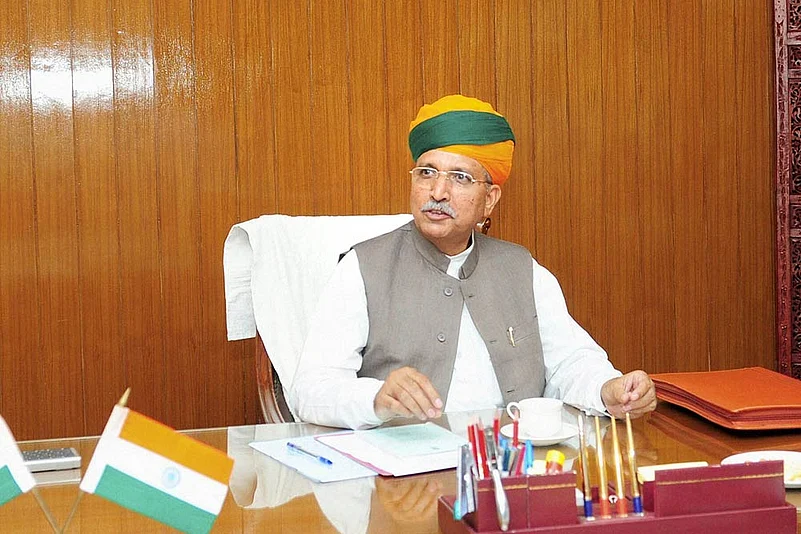
From administration to representation
The documented transition point is the 2009 general election, at which he was elected to the 15th Lok Sabha from Bikaner (SC). The official record does not narrate the decision to leave the service, and no account of it is offered here.
What the record does show is continuity of subject matter. The committee work recorded against his name between 2011 and 2014 — Co-Chairman of the Committee on the Reservation in Judiciary under the National Commission for Scheduled Castes — belongs to the same field as the portfolio he holds today. The memberships recorded from 2010 onwards — the Executive Committee of the Indian Parliamentary Group, the General Council of the National Institute of Rural Development, the Governing Council of the Sarva Shiksha Abhiyan — are institutional bodies of exactly the kind an administrator works with.
Sources
- 1Digital Sansad, Lok Sabha — member biography, Shri Arjun Ram Meghwal (Member No. 4399). sansad.in/ls/members/biography/4399
- 2Press Information Bureau, Ministry of Law and Justice — Release ID 2024165, 11 June 2024.